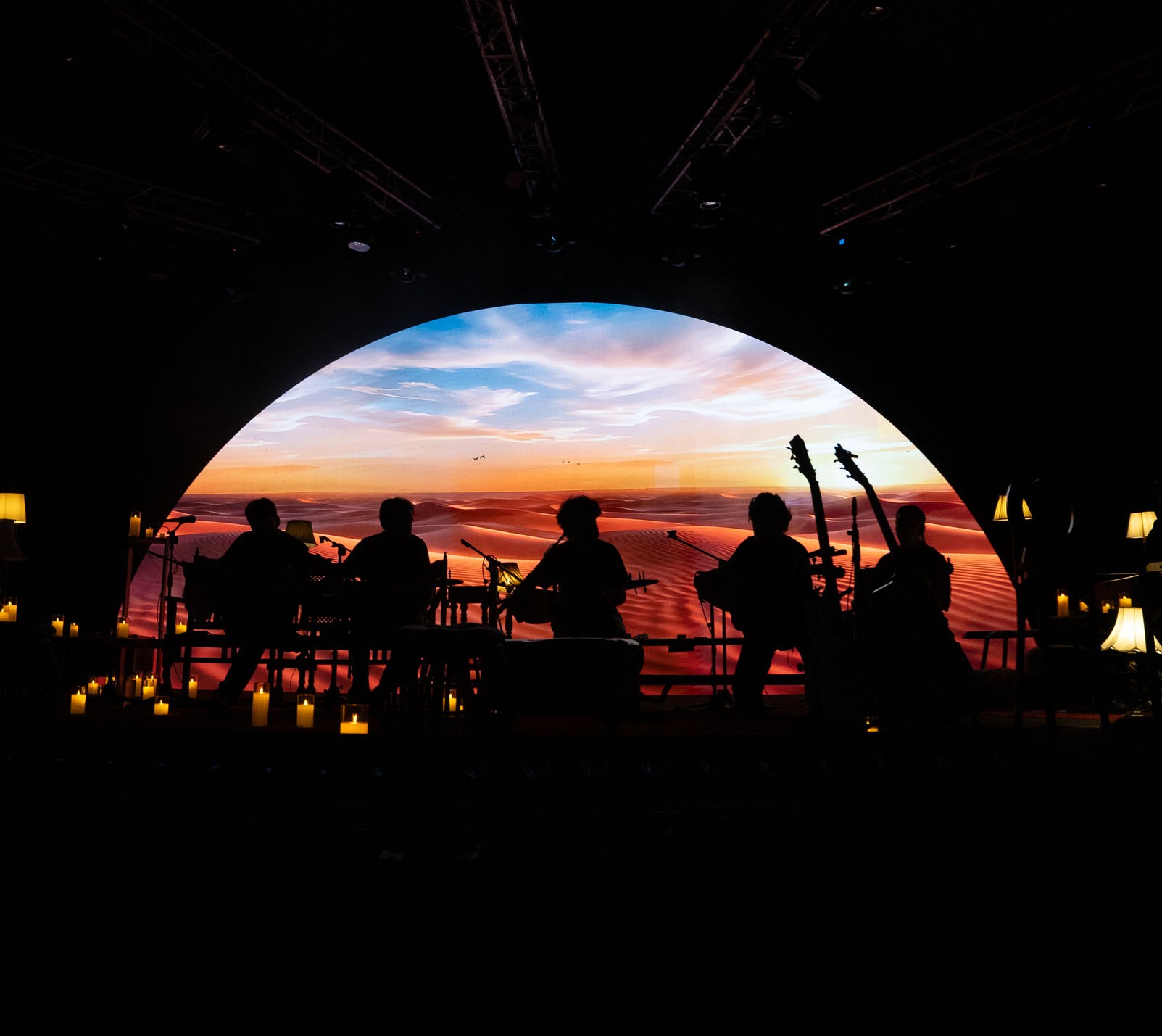
On a warm Karachi evening this month, on the 8th of May, at the Arts Council of Pakistan, the sound of mountain melodies drifted across a hall filled with people singing along to songs that have defined an entire generation. Familiar tracks such as ‘Laari Chooti,’ ‘Pi Jaon,’ ‘Aadat,’ and ‘Sab Bhula Ke’ returned with new emotional weight, carried not only by electric guitars and contemporary vocals, but by the earthy textures of traditional instruments from Gilgit-Baltistan and Chitral. For many in the audience, Mehfil was more than a concert.

After a widely celebrated debut in Lahore last year, in 2025, Mehfil returned this May with an ambitious three-city tour spanning Karachi, Islamabad, and Lahore. Conceived by Giraffe Private Limited, the project was co-founded by Muhammad Ibrahim and acclaimed producer Zulfiqar Jabbar Khan, better known as Xulfi. Yet unlike a conventional music festival, Mehfil is attempting something more layered, placing Pakistan’s diverse musical traditions into conversation with one another through live performance.

This month, the Karachi concert marked the opening chapter of the 2026 tour and brought together the LLMC Ensemble from Hunza, a collective of young musicians trained in the indigenous musical traditions of Gilgit-Baltistan and Chitral at the Leif Larsen Music Centre (LLMC), alongside Farhan Saeed and Call The Band. Curated by Xulfi and Sherry Khatak, the evening moved fluidly between genres, regions, and generations. Traditional compositions such as ‘Ashurjan’ and ‘Ya Qurban’ sat comfortably beside contemporary favourites like ‘Halka Halka Suroor’ and ‘Khat,’ creating a performance that bloomed from both nostalgia and reinvention.
At the heart of Mehfil’s emotional resonance is the preservation work being carried out through the LLMC in Hunza. Established by the Aga Khan Music Programme and the Aga Khan Cultural Service – Pakistan in partnership with the Norwegian Embassy, the centre was created to safeguard the indigenous musical traditions of Gilgit-Baltistan and Chitral at a time when many traditional forms risk fading into obscurity.

Using instruments such as the Dadang, Chitrali Sitar, Xhiggini, rubab, and flute, the ensemble reinterprets familiar songs through a distinctly northern soundscape. The effect is striking. Songs audiences thought they knew suddenly feel transformed, carrying entirely new emotional textures while still retaining the nostalgia attached to them.

“Mehfil came from a very simple but powerful desire: to create a space where different musical worlds could meet each other with honesty, warmth, and excitement. We often inherit songs in one form and one memory, but when those same songs are reinterpreted through different instruments, regions, and sensibilities, they begin to reveal new emotional colours,” Xulfi shared in a statement.
“What moved me most in the first edition was seeing how naturally these worlds came together. The LLMC Ensemble brought such depth, discipline, and soul to the music, and when that met artists and songs people already carry in their hearts, something fresh happened. Nostalgia and rediscovery. Mehfil is about giving Pakistan’s musical diversity the scale, care and stage it deserves.”
That sense of rediscovery is central to Mehfil’s appeal. Pakistan’s music industry has often struggled to create sustained live experiences that move beyond celebrity driven performances. Mehfil instead leans into collaboration, cultural exchange, and reinterpretation. There is an intentional effort to give regional sounds and younger musicians the same scale and stage often reserved for mainstream acts.
The project also carries traces of Humnava, an earlier initiative led by the same team that brought together artists from Pakistan, France, Germany, Algeria, and Zambia in Hunza for collaborative residencies focused on music and cultural exchange. That same spirit now finds a more public expression through Mehfil, where heritage is not treated as static preservation but as something alive and evolving.

Importantly, Mehfil arrives at a moment when conversations around cultural identity and preservation feel especially urgent. Across South Asia, younger audiences are increasingly reconnecting with regional languages, folk traditions, and indigenous art forms that previous generations often viewed as peripheral to modern culture. Mehfil taps into that longing while presenting it through a contemporary, accessible format.
Following Karachi, Mehfil will now travel to Islamabad on the 16th of May before concluding in Lahore on the 23rd of May.



Leave a Reply