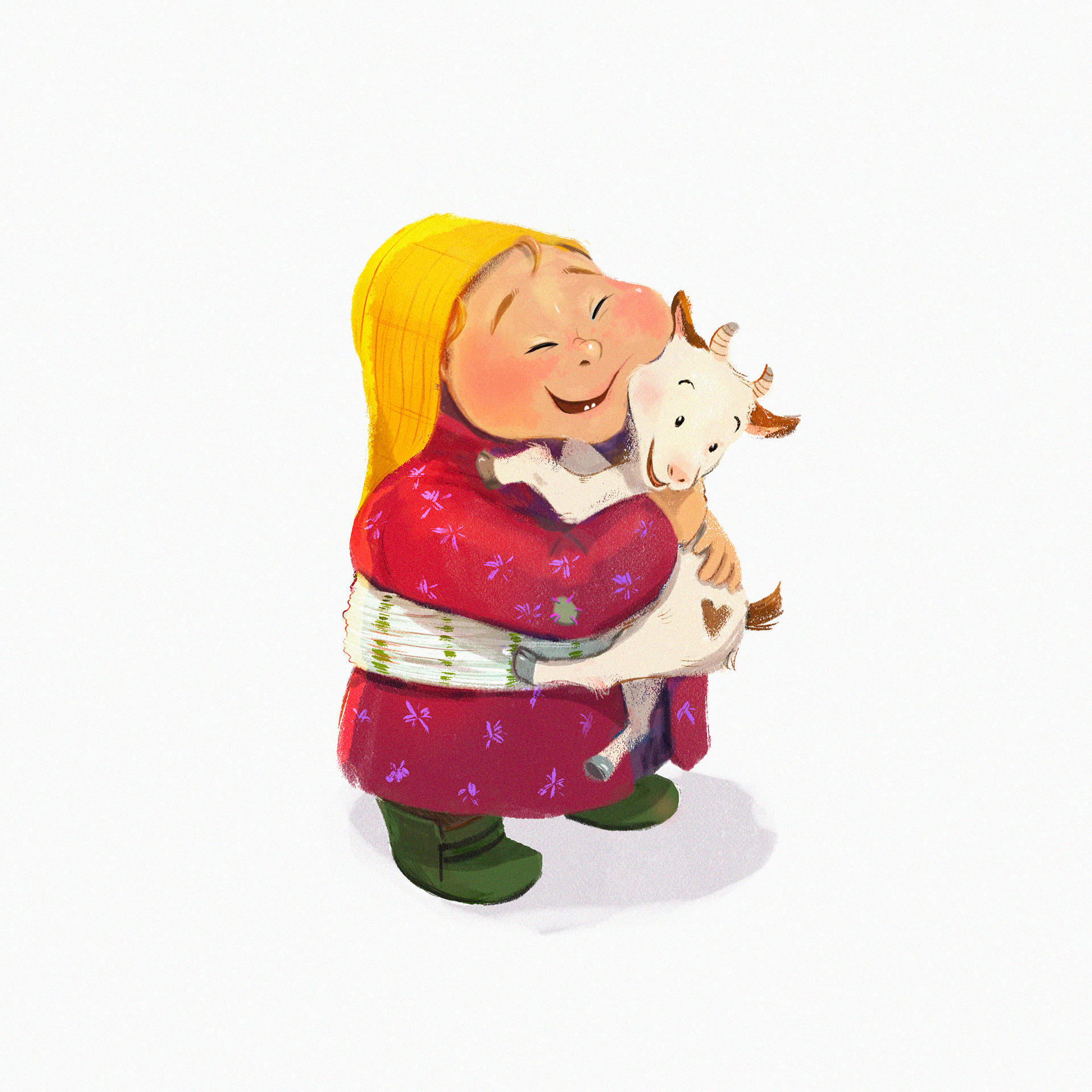
There’s something subtly luminous about Sara Aziz’s work, the kind of softness that does not ask for attention and yet stays with you long after you’ve turned the page. Her lines are spare, her colours often gentle, but within that restraint lives a remarkable emotional depth, a tenderness that is personal and yet universally understood. It’s the kind of art that trusts the viewer, that leaves room for memory and feeling.
Perhaps that sensitivity comes from a life lived across contrasts. From growing up in a family of doctors in Lahore, where a different future might easily have been mapped out for her, to carving a path shaped entirely by instinct, curiosity, and an enduring love for drawing. From the studios of Duncan of Jordanstone College of Art & Design in Scotland to the often unpredictable rhythms of motherhood and migration, Sara’s journey has unraveled with a conviction that feels rare. At every stage, there’s a sense of returning, not to a place, but to a way of seeing the world.

In recent years, that way of seeing has found its most intimate expression in children’s illustration. What began as a personal mission, creating for her own child, has grown into a body of work that now travels across borders and languages, reaching young readers through collaborations with global children’s book publishers like Scholastic and Penguin Random House. And yet, even as Sara’s practice expands, there’s a sense that the heart of it remains unchanged, rooted in wonder and the fleeting moments that children notice so instinctively.

You grew up in a family of doctors but chose a very different path. What gave you the clarity and courage to pursue art so wholeheartedly?
Growing up, I was so passionate about drawing and painting that it always felt clear to me that I wanted to do something creative with my life. My real strength, though, came from my parents who have always supported and encouraged me wholeheartedly. It’s much easier to believe in yourself when the people you look up to believe in you too.
Your work is known for its minimal, cartoon-like style, with lovely movement and emotion. How did you arrive at this visual language, and what draws you to simplicity in storytelling?
It took a lot of drawing. I’ve experimented with all kinds of mediums and subject matter, and over time, your strengths and preferences start to reveal themselves. That’s how a “style” begins to take shape – but it’s important to remember that an artist’s style is fluid and always evolving. I often adapt my approach depending on the message I want to convey.
For the Aunty series, for example, I kept things very minimal because I was relying on a single image to spark nostalgia or relatability. With picture books, which are meant to be explored and reread many times, I tend to create more detailed illustrations. As for simplicity, people often assume simple drawings are easier to make, but that’s rarely the case. Minimal work can be incredibly challenging. Each stroke carries weight, so it has to be intentional while still feeling natural and spontaneous. I really admire that kind of impactful simplicity, and I think it reflects how I try to live my life as well.

Illustration seems to have taken a new direction when you were expecting your first child. How did motherhood reshape your creative instincts and priorities?
I was trained and practiced as a fine artist before becoming a mother. Having children reintroduced me to the softer, gentler aspects of life. My first book began as a small gift for my son, but I was enamoured with the process of illustrating for children. The biggest shift was in what I could channel creatively – glee, innocence, silliness. It opened up a whole new emotional space for me, and I was hooked.
Your first book, Laam se Limopani, came from noticing a gap in quality Urdu children’s literature. Why was it important for you to create in Urdu, and what did that process teach you?
I created Laam se Limopani for my son. I wanted to read him an Urdu qaida with illustrations that felt engaging and thoughtfully made – something I felt was missing at the time. Growing up, my siblings and I loved picture books, and our favourites were always the ones with the most beautiful illustrations.
I realized that the lack of visually engaging Urdu books may have contributed to us not feeling as connected to our mother tongue and I wanted things to be different for my son. Now that I live in Canada, I appreciate even more how important it is to celebrate and preserve Urdu. It’s been wonderful to see so many beautiful Urdu books being published in recent years.

You’ve illustrated nearly 40 books and now work with publishers like Scholastic and Penguin Random House. How has your creative process evolved as your career has grown?
I feel like I learn something new with every project. On a practical level, I’ve become more efficient with the tools and software I use, and I’ve learned to streamline my process. I’ve also learned the hard way that it’s better to work steadily and meet milestones with care than to rush to the finish line.
But one of the most interesting parts has been what I’ve had to unlearn. Coming from a fine arts background, I assumed I could easily transfer those skills into children’s illustration – but it’s a completely different discipline. Creating for children requires a careful balance of whimsy, emotion, and intrigue. My understanding of that balance is still growing every day.

You’re currently developing your debut author-illustrated book with Seuss Studios. What has it been like stepping into both roles – writer and illustrator?
It’s been incredibly exciting. I used to write when I was younger, but I was hesitant to pursue it professionally. Being able to create a book in both roles, especially with Penguin Random House team, feels like a wild dream coming true.

Your work carries a strong sense of warmth, wonder, and kindness. What do you think children’s illustration can offer that other forms of art cannot?
What makes children’s illustration unique is its core audience. While all forms of art can express joy, hope, and whimsy, this kind of work is a direct communication with children, and that’s very special. And honestly, it’s just really nice to think about the things kids think about all day instead of dull, grown-up thoughts. I highly recommend it!

You’ve spoken about your children being your greatest source of inspiration. How do they shape the stories you tell or the way you see the world?
I like that children look at the world with such curiosity and wonder. I like that kids will find a little rock, think to themselves, ‘This is perfect, I will give it to mommy’ and then dutifully bring it home in their little pockets and present it with shining eyes and puffed up chests. That kind of perspective is incredibly pure. My kids are always showing me, or should I say reminding me, to look at the world differently – with openness, imagination, and appreciation for small things. I learn a lot from them.

For Pakistani authors and illustrators, what’s the best way to get a foot in the door at an international publishing house? What advice would you give to creatives working locally?
First, it’s important to understand that children’s publishing is a vast and well-developed industry. There’s definitely competition, but there’s also a lot of opportunity. Consistency and hard work really matter.
Take the time to research what publishers and art directors are looking for. Study the kind of work you admire and try to understand what makes it effective. There are great resources online, and organizations like SCBWI offer a lot of useful guidance. Building a strong, thoughtful portfolio is key. Find the right platform to showcase your work, and focus on creating memorable, meaningful pieces rather than just posting frequently – though some consistency does help. It’s about finding a balance.
Finally, try to find the right agent. Many large publishing houses work primarily through agents, and my agent, Kayla, played a big role in introducing my portfolio to the right people. The good news is that all of this is now accessible online, so illustrators in Pakistan can absolutely land international projects if their work and work ethic are strong.
Header illustration: Sara Aziz


Leave a Reply