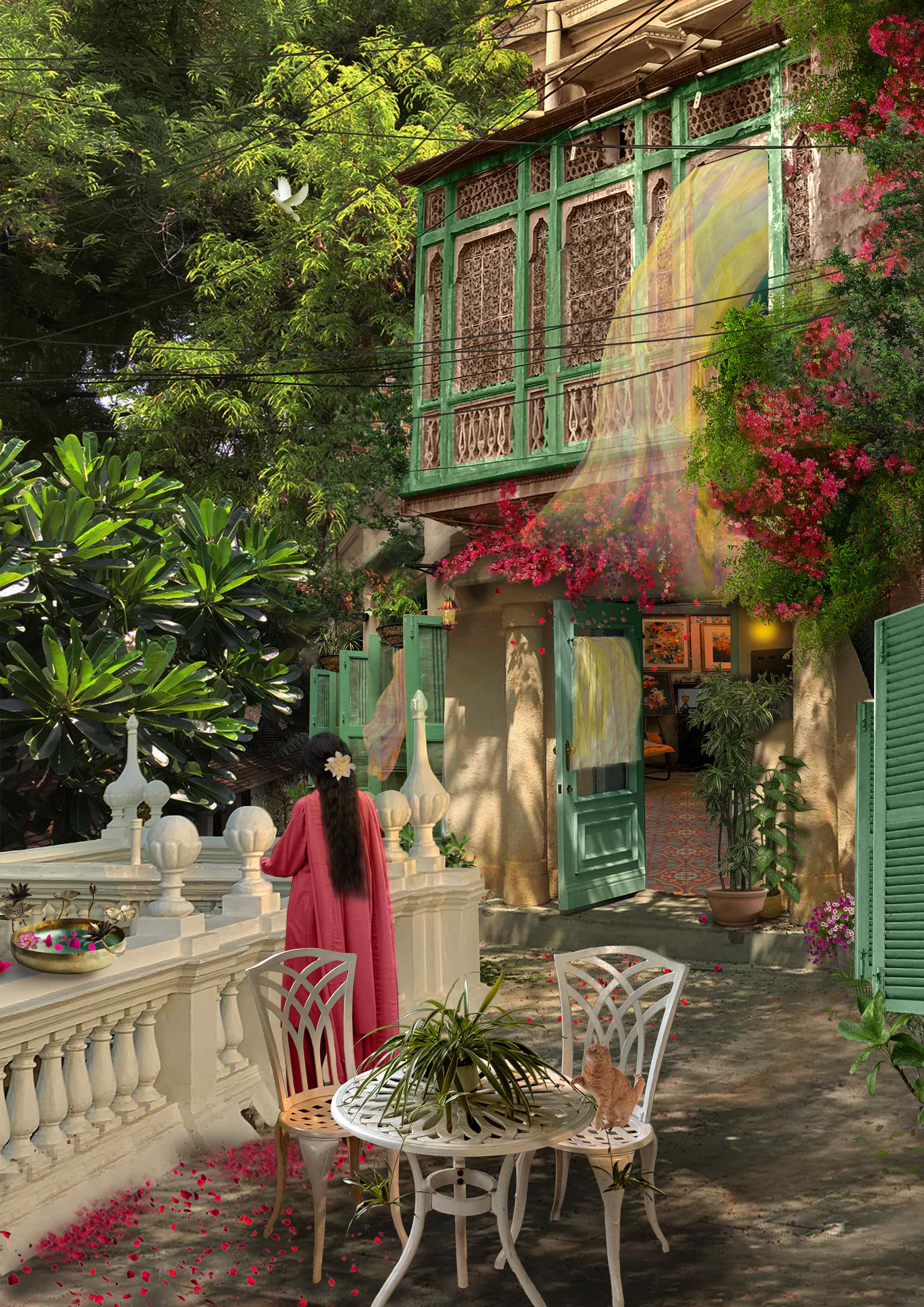
Some people leave home. Others spend a lifetime trying to recreate the feeling of it. British-Pakistani Architectural Designer Areesha Khalid belongs to the latter. Through nostalgic illustrations, layered interiors, and carefully observed details of South Asian homes, the London-based architectural designer explores what it means to belong to two places at once. Having left Pakistan at the age of 10, Areesha’s work sits at the emotional center of the diaspora experience, longing, memory, identity, and the quiet ache of a home carried through stories rather than geography.
From fading walls and handwritten signs to the warm, lived-in corners of our grandmother’s homes, her art preserves the textures of memory that so many people fear losing with time. In this interview with FLWL, Areesha opens up about identity, nostalgia, creative burnout, plagiarism, and why the smallest details often hold the deepest stories.
Can you share how your social media journey began, and what inspired you to use it as a platform to showcase your art?
It began very organically, I never actually intended to sell my art though. I just started posting my work that was quite experimental. I was making it for fun in my free time when I got furloughed from my architecture job during Covid and continued this while studying for my Masters. The intention for posting my work was always just to form an online portfolio to get traditional architecture roles after university. I got a few messages from people requesting to purchase my work. After selling a handful of prints through DMs, I decided to set up a little shop and it just took off, and I refined it over the years. I feel very grateful that people connected to my work in that way.

Your work beautifully blends Western and South Asian culture. How does your identity as a British-Pakistani inform your artistic choices, particularly in depicting domestic spaces and nostalgia?
When I first moved to the UK at 10, I hated it here and wanted to desperately go back home. I missed my friends, my school, my life as it was. I didn’t quite fit into the very white-dominated small town my parents had moved to. Eventually, I learnt to blend in by putting my identity somewhat on the backburner when it comes to being loud and proud about it, but always kept it very close to my heart. When I moved to London for university at 18, I met people from all over the world, it made me feel so seen, I was no longer the odd one out. This is when I began to be more outward about my heritage and wanted to honour it and learn more about it.
I turned to the elders in my family for stories of their childhood, as well as yearly trips to Pakistan throughout my childhood that had still kept me connected to home. Due to these yearly trips, family stories and the media I grew up consuming (Bollywood films, e.g., Sanjay Leela Bhansali, Pakistani dramas etc.) I had a fairly good understanding of the overall culture and built environment back home in order to make my art.
A lot of my work is quite a romanticised depiction of home. This is because a lot of it is based directly off stories told by my mum and grandmother, where certain spaces sit as an integral part of their memories. I refer to them as humble corners of South Asian homes that hold countless precious memories. The spaces are mundane, yet the descriptions they give from memory are dreamy and nostalgic. My work aims to capture this dreamy nature of memory into a still image. This is also the very thing that connects many globally to my work. They are able to feel that shared sense of nostalgia through an image.

In your coffee table book, Diaspora Digest, and your prints, you capture a deep sense of nostalgia. How do you translate emotions of longing and “home” into visual form, and why do you think these resonate so strongly with the diaspora?
I believe the spaces that we occupy tend to soak in the culture and daily lives of the people that they house. Spaces can tell people’s stories through colour, pattern, writing, signage, wear and tear and much more. Capturing this ‘lived in’ quality of space is essentially what conveys the nostalgia and longing in my work. It’s what people remember when they leave their home behind. The little things that made their homes truly theirs.
When I visit anyone’s home, specifically older homes which I have a fascination with, of course the overall design features stand out and are beautiful. But what tells me a story of those that lived there and how they made this house into their home is the wear and tear. The hand written make-do signage drawn on by a shop keeper in Androon Lahore and the several shop keepers who have drawn on top of it, leaving traces of old paint/chalk slightly peeking through underneath. It’s literally layered with history. It adds narrative and life to spaces.
That wall in your nani’s home that has faint handprints, where the ground was uneven so she would use it as support while walking through the corridor, those details matter. To me, perfectly painted walls don’t hold the tangible prints of my grandmother’s everyday life that I can touch and connect with years after she’s gone. So for me, wear and tear, and the evidence of humans living and inhabiting a space, will always be worth drawing.

Recently, some of your illustrations were plagiarised and sold by another Instagram page. What did that experience teach you about protecting your work?
It was an exhausting experience to go through. Thankfully, I have artist insurance and a good art lawyer that gives me great advice and helps me out in times like these. We were able to send the person a legal notice to take the work down. I have learnt a lot over the years of doing this, I’ve made many silly mistakes and learnt and grown from them and put systems into place to protect myself and my work to some extent. However, it is a bit inevitable in this digital age to completely avoid these things, unfortunately. But I’m grateful to have a very supportive community who have my back. It also helps to have a very distinct design language whereby anytime anyone sees my work being plagiarised, they always flag it to me. After taking some basic measures, I choose to really pick my battles and have faith that whatever rizq is meant for me, cannot be taken away from me.

With over 100k followers, your work clearly resonates. How do you engage with your audience while staying true to your artistic vision, and how has feedback shaped your creative process?
I’m lucky to have found the best community online. We are almost always on the same page and have the same ideologies and love for design. This keeps us connected without the typical algorithm manipulation that creators may need to do. I don’t feel pressured to post consistently just for the algorithm’s sake. Especially with art, it comes when it comes, I really can’t force it. I’m grateful that my audience is there whenever the next art pieces are ready and they show up. I went through a rough creative block last year where I couldn’t create new work for over 7 months but my audience was still patient and there when I was ready to create again. Forever grateful for this because I truly believe the pressure of showing up on social media ruins art for many creatives. I never lead my work with “what would the internet like?” I just make what I feel and thankfully people connect with it.
The best feedback I get from my audience is the personal stories they tell me that connect them to specific pieces of mine. Sometimes they’ll even send photos of their parents’, grandparents’ or great grandparents’ homes. These stories then subconsciously inform new works of mine. My community truly, actively feeds into my creativity.

Are there new mediums, themes, or collaborations you’re excited to explore in the coming years? Also, what are you currently working on?
I’d love to work on more physical products and spaces. I loved designing a scarf for Veiled Collection and my teahouse for CHACHA festival in NYC. I would love to design some more home decor or wearable bits and more public installations where people can feel and walk through the world I’ve created. Additionally, some more traditional set design work would be fun! Currently, I’m working on my first physical (non-print) product. I hope it’ll be a timeless, heirloom piece. I’ve spent a year working on it alongside very talented artisans and it’s almost done.
Are there heritage sites or spaces in Pakistan that you’ve personally visited that inspire you?
My favourite city to visit for heritage sites was definitely Bahawalpur and of course Lahore is a close second. But Bahwalpur is extremely underrated. It has the most stunning palaces built in a beautiful amalgamation of Indo-Saracenic Architecture. I have never created more art based on one city. Working in collage medium, the places I visited in Bahwalpur formed a huge chunk of my pieces in the last few years. Particularly the Bahawalpur Central Library which I recommend to all history and architecture lovers to visit at least once, it’s the most serene, beautiful library. Also, Sadiq Garh Palace, which is now completely abandoned and falling apart but the withering building stands to tell the story of its past inhabitants and the era where it once stood in all its glory. Today it seems almost stuck in time, falling apart but you can still see the immense beauty it holds.

Areesha, as a young creative using social media to showcase her art, how important is personal branding? I guess what I’m trying to say is, it doesn’t cut ice to stay hidden under a rock, right? You have to put yourself out there a fair bit…
Yes, personal branding is so important. The only way to stand out among a sea of people trying to be seen is simply to be your most authentic self because no one else can do YOU the way you can. And just show up. Don’t wait to create the most perfect art, just post what you’re working on, your process, your design ideologies etc. Perfection is definitely the thief of progress. I am a huge believer in just start first, make it look good later. You’ll be surprised how many people resonate with this.
Header image: Areesha Khalid


Leave a Reply