
By Umair Hashmi
Some stories are not told so much as they are inherited. They move quietly through generations, carried not in certainty but in fragments, in lowered voices, in pauses that say as much as words. The story of Shakuntala in the Old Hostel building of Lahore College has always belonged to that category for me, part memory, part myth, and entirely alive in the way it refuses to settle into fact.
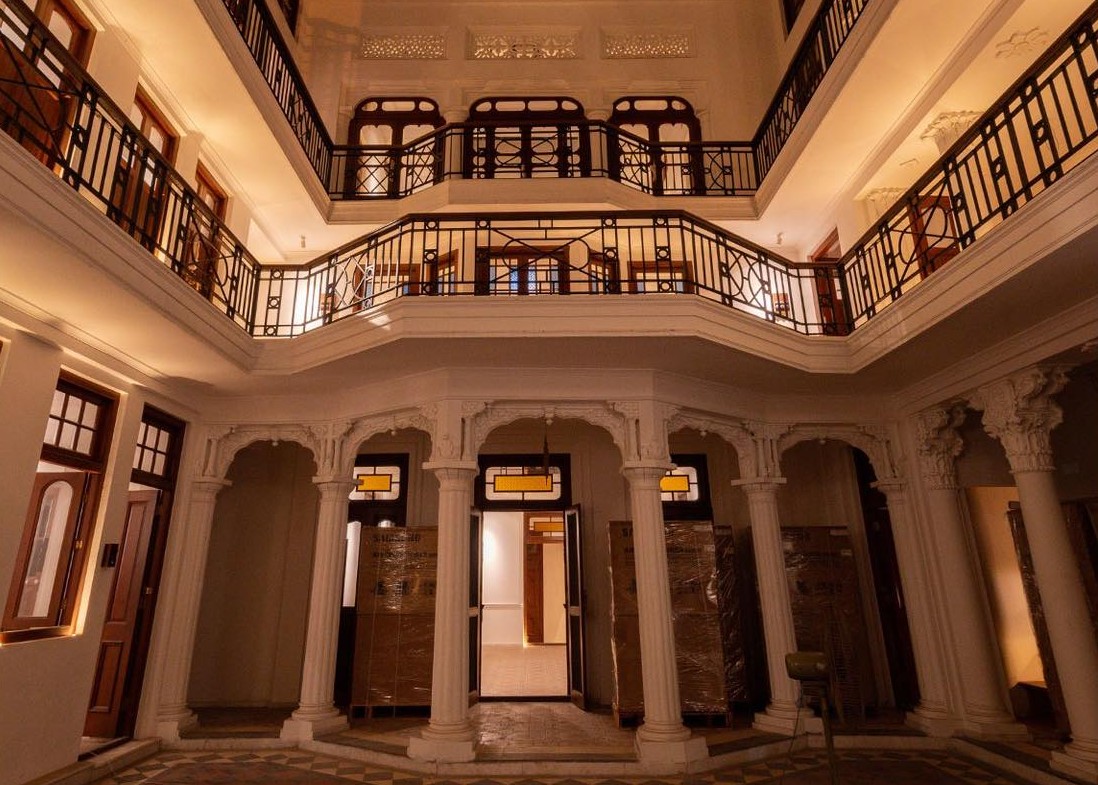
I first encountered her in the 1990s, inside my mother’s office in the Old Hostel. The building itself felt like a keeper of time. High ceilings that seemed to hold on to echoes, long corridors that stretched further than they should have, and a stillness that made even daylight feel measured, almost hesitant. I would spend hours there as a child, drifting between observation and imagination, slowly becoming aware that the space was not empty even when it appeared to be.
Shakuntala. No one ever introduced her as a story. She arrived instead through fragments, passing remarks between colleagues, careful smiles, conversations that softened as they reached her name. She had been a warden, they said, a woman whose presence once defined the rhythm of the hostel. After her death, uncertain and never fully explained, something in the building shifted.
Her room remained untouched. Not preserved in any formal sense, but left as it was, as though interruption itself had been paused mid-sentence.

As a child, I did not question this. I absorbed it. The Old Hostel did not feel haunted in the way stories often suggest. It felt aware. As though memory itself had settled into its walls and chosen not to leave.
The name Shakuntala carries another weight beyond Lahore. In the Mahabharata, she is the mother of Bharat, a figure tied to lineage, origin, and the very idea of a land taking shape through memory and return. She is remembered after absence, recognised after loss, her story moving through separation and reunion across generations. It is perhaps no coincidence that the Shakuntala of the Old Hostel seems to exist in a similar register, less as a figure and more as a continuity. A presence that connects those who passed through the building before Partition, those who lived through its aftermath, and those of us who arrived much later, unaware that we were stepping into a place already saturated with narrative.

What has always fascinated me most is how the story refuses to remain still. Each retelling reshapes it slightly. Oral tradition does not preserve in the rigid sense; it breathes. It adjusts. It remembers differently depending on who is speaking and who is listening. Yet something essential remains intact. Shakuntala’s name persists, carrying with it both familiarity and unease, as though the act of forgetting were never quite possible.
Looking back now, I realise how easily the story braided itself into something larger. Personal memory, collective history, and inherited myth began to overlap. The Old Hostel, like Shakuntala herself, became less a physical structure and more a threshold where time folded in on itself. The idea of footsteps in empty corridors, of doors left slightly ajar, of a presence felt rather than seen, mattered less for their literal truth and more for what they held together: the sense that the past is never entirely past.

In that sense, Shakuntala is not only the warden remembered by those who once lived in the hostel, nor only the echo of a mythic figure from ancient narrative. She exists somewhere in between, in the overlap where history softens into imagination and imagination hardens into memory. Perhaps that is why such stories endure. They are not fixed accounts but living forms, carried forward not because they are resolved, but because they are unresolved.
In the corridors of Lahore College, long after the voices that first spoke her name have faded, Shakuntala remains. Not as a figure of fear, but as a quiet insistence. A reminder that buildings remember, that stories accumulate like dust in corners, and that some presences do not depart so much as they disperse, threading themselves into the places we think we know.
Her room still sits untouched, like a ruin held in suspension. Not haunted in the dramatic sense, but held in a softer, more unsettling way, as though time itself once paused there and never fully resumed.
And perhaps that is what makes her story endure. Not that she lingers as a ghost, but that she continues as memory, refusing to be fully explained, and therefore refusing to disappear.
The author is an oral historian and the Founder of Lahorenamah. This is his debut article.
Header image: Raja Ravi Varma




Leave a Reply