There are cities that remember, and then there are cities that are remembered through what they choose to save. In Pakistan, where time moves quickly and skylines shift almost overnight, the question of what we carry forward has never felt more urgent. Our heritage is not just brick and lime, not just carved wood and fading frescoes, it is memory made visible. And across the country, through the quiet, persistent efforts of individuals, institutions, and creative practices, that memory is being restored, and, in many ways, reimagined for the future.
Recently, a series of arresting images and videos surfaced online, shared by Raees Faheem Associates, an architectural firm based in Lahore. Established in 1994 by two architects, the firm has, over the years, built a body of work that moves between the contemporary and the historic with ease. Their projects span residential, commercial, educational, corporate, and religious spaces, but it is their engagement with heritage that feels particularly resonant at this moment in time. In a country where conservation is often sidelined by rapid development, their work reads as both an act of care and a quiet insistence on continuity.

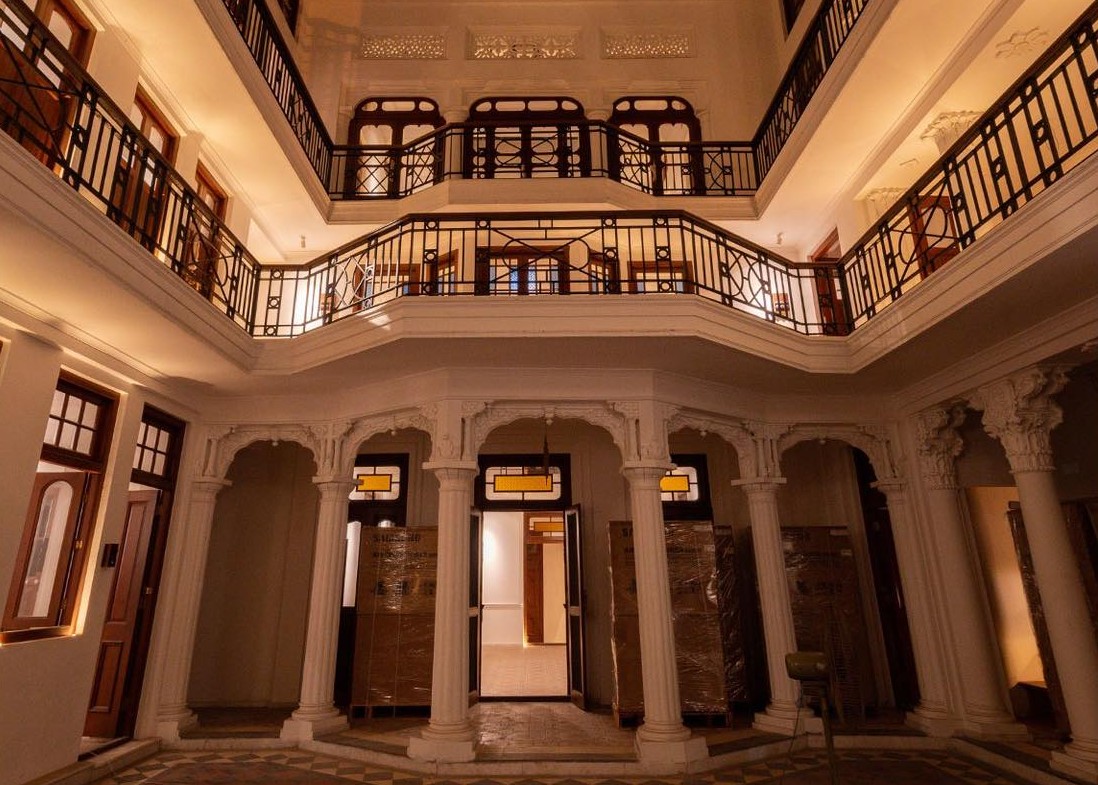
The footage that has captured so much attention is from Sita Ram Haveli, a once neglected structure tucked between Lahore’s food street and the historic entryways of the Lahore Fort and Taxali Gate. For years, the haveli stood in a state of disrepair, its walls bearing the weight of abandonment, its details slowly dissolving into obscurity. Built in the 1920s as the residence of Lala Sita Ram Mehra, then Municipal Commissioner of Lahore, the haveli is an architectural conversation in itself. It brings together Mughal techniques, Rajput influences, and colonial sensibilities, with traces of Art Deco emerging through its ornamental railings and sculpted plasterwork. Its traditional courtyard layout, rising across five storeys, speaks of a time when homes were designed as living ecosystems.
By the time Raees Faheem Associates undertook its restoration in 2023, the building was in urgent need of intervention. What followed was not simply a project, but a process grounded in patience and respect. Detailed documentation, structural analysis, and ongoing internal dialogue shaped every decision. The haveli was approached in three parts, Maghrib, the Central Haveli, and Mashriq, each reimagined with care. The central space now opens itself as an art gallery, while the Mashriq wing extends into an area that will host artist residencies. The Maghrib section, in contrast, is conceived as a logistical backbone, complemented by a rooftop space that offers sweeping views of the Food Street courtyard, the Badshahi Mosque, and the Lahore Fort. It is a restoration that does not freeze the building in time, but allows it to live again, to gather people, to hold conversations, to be seen.

What makes this project particularly compelling is its restraint. Rather than overworking the structure or erasing its age, the approach has been one of minimal intervention, allowing the building to retain its scars and textures. There is an understanding here that restoration is not about perfection, but about preservation. About knowing where to repair and where to simply let be. The use of original materials, the careful reinforcement of structural elements, and the preservation of intricate detailing all point to a philosophy that values authenticity over spectacle.

In its new life as an art gallery, Sita Ram Haveli stands as more than a restored building. It becomes a bridge, connecting past and present, architecture and art, memory and possibility. It invites a different kind of engagement with heritage, one that is not confined to nostalgia but extends into lived experience. Visitors will walk through its corridors not as spectators of history, but as participants in its continuation.

Across Pakistan, similar efforts are beginning to take shape, some small, some more visible, all equally significant. They remind us that preservation is not a passive act. It requires intention, resources, and above all, a collective will to value what came before us.
Header image: Aqeel Meer



Leave a Reply