
For generations, the conversation around heritage in Pakistan has been dominated by monuments. We celebrate the restoration of a centuries-old mosque, applaud the conservation of a Mughal fort, or campaign to save a crumbling haveli. These are important victories…but they tell only part of the story. A city is not remembered solely by the buildings that survive, but by the lives that unfold within and around them.
Heritage is as much about people as it is about place. It exists in the calloused hands of an ageing craftsman who still shapes metal using techniques passed down through generations. It echoes in neighbourhood dialects that are slowly disappearing, in recipes prepared without written measurements, in the rhythm of a traditional marketplace, in the poetry recited at family gatherings, and in the faded signboards painted by hand decades ago. It lives in customs, skills, rituals, objects and memories that rarely make it into museums, yet define who we are.

These forms of living heritage are often the most vulnerable. Unlike monuments, they cannot simply be restored once damaged. When an artisan dies without an apprentice, when a community is displaced, when a traditional craft can no longer compete with mass production, or when younger generations lose their connection to the stories of their own neighbourhoods, an entire archive of knowledge disappears…often without ceremony or notice.
This is why a new generation of cultural practitioners has become so important. Across Pakistan, young historians, curators, artists and community organisers are challenging conventional ideas of conservation. They are asking us to look beyond bricks and mortar, recognising that preserving heritage also means preserving dignity, livelihoods, craftsmanship and collective memory. Rather than treating history as something frozen in time, they see it as something that must continue to be shared and reimagined.
Among them is Mohsin Faraz, whose work in Lahore’s Walled City offers a compelling example of what heritage can look like when it is rooted not only in preservation, but in people.

At an age when many of his contemporaries are building careers in technology, finance or marketing, Mohsin has chosen a different calling: safeguarding the stories that make Lahore what it is. Born and raised in the Walled City, where his family has lived for generations, his understanding of heritage was shaped long before he studied history or archaeology. It was formed by growing up in streets where centuries coexist with the present; where shrines, havelis, workshops and family homes are woven into everyday life, and where history is encountered not in textbooks, but on the walk to the corner shop.
Living in the Walled City, he says, teaches you that heritage is never static. It is constantly adapting, negotiating and, at times, struggling to survive. For those who live there, heritage is not an abstract concept or a tourist attraction. It is inseparable from livelihoods, infrastructure, community and identity. It is both beautiful and complicated.

That lived perspective has shaped the work Mohsin has spent the past eight years building. Through the Society for Living Heritage, Lahore Virsa and a number of collaborations with cultural organisations, he has worked to shift the conversation away from preservation as a purely architectural exercise. Instead, he advocates for an approach that places communities at its centre, recognising local residents as custodians of heritage rather than passive observers of it.
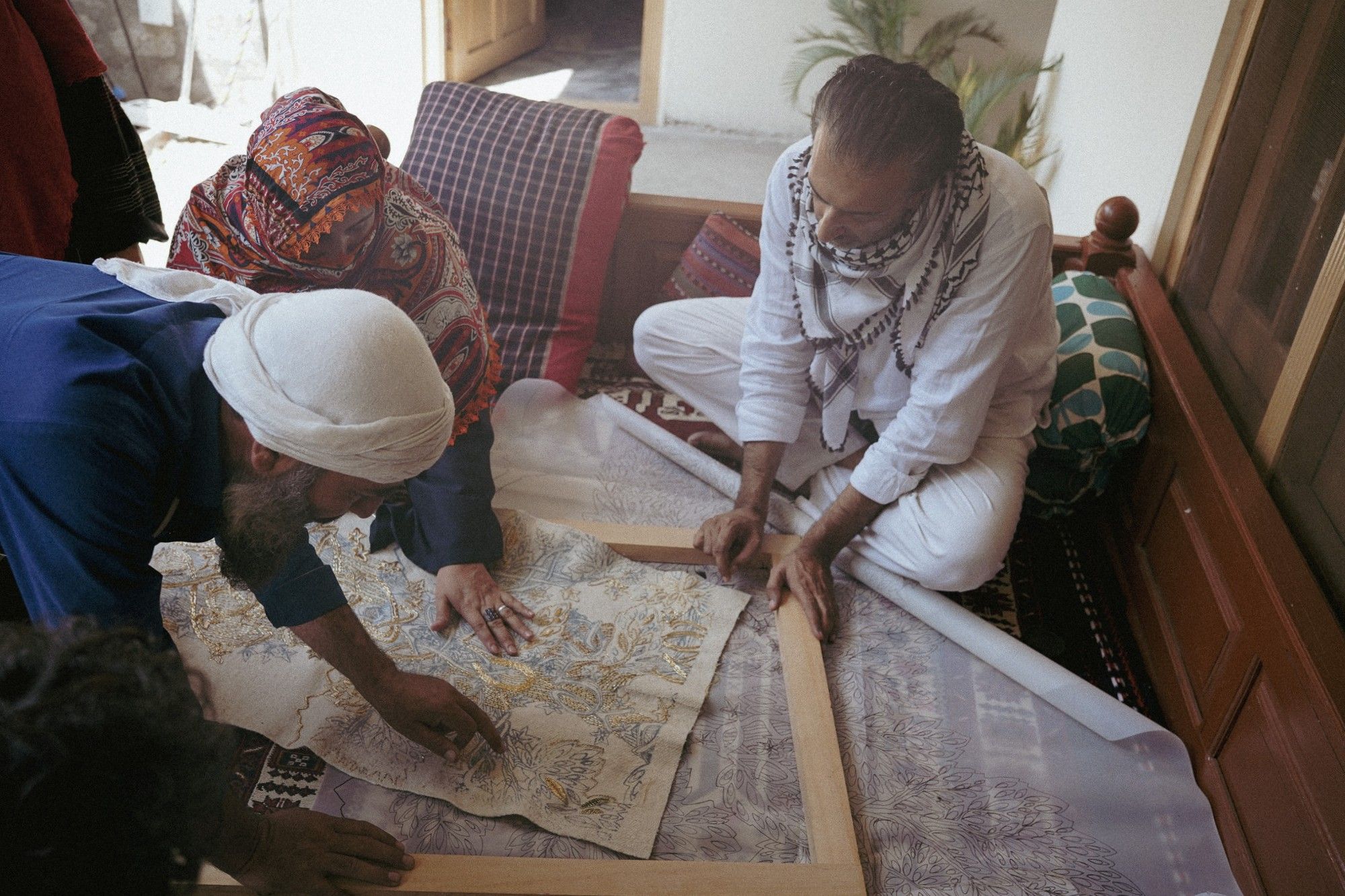
This philosophy is perhaps best illustrated through Art Ratan, one of his most significant initiatives. The project focuses on reviving Chitrai metalwork, a traditional craft that once flourished in the region but now faces an uncertain future. For Mohsin, however, the disappearance of a craft represents something far greater than the loss of a particular technique.
“When a craft disappears,” he reflects, “we lose accumulated knowledge, identity and the connection between generations.”
It is a sentiment that speaks to the wider challenges facing traditional artisans across Pakistan. The pressures of industrial production, shrinking markets and declining apprenticeships have left many centuries-old skills at risk of disappearing altogether. Reviving them requires more than exhibitions or nostalgia. It demands long-term investment, meaningful opportunities for artisans to earn sustainable livelihoods, and perhaps most importantly, a renewed sense of value for manual skill in a rapidly changing world.
Mohsin’s interest in heritage extends beyond the intangible. Over the years, he has assembled a remarkable personal collection of nearly 4,000 artefacts, ranging from manuscripts and textiles to everyday domestic objects, tools and metalwork. Yet he is quick to point out that he is not interested in collecting rare or expensive possessions for their own sake.
“I don’t collect objects, I collect the lives embedded within them.”
It is an observation that reveals as much about the collector as it does about the collection itself. The objects that fascinate him are rarely those associated with kings or empires. Instead, they are the ordinary possessions that bear the marks of everyday use: a repaired cooking vessel, a worn tool, a handwritten ledger, an embroidered textile passed from one generation to the next. These are the pieces that illuminate how ordinary people lived, worked and created meaning long before they became history.

That fascination with everyday life also explains why Mohsin has become one of Lahore’s most thoughtful guides to the Walled City. His heritage walks are designed not to romanticise old neighbourhoods or turn residents into attractions, but to encourage visitors to understand the city on its own terms. Every street has a story, every workshop a lineage, every doorway a memory that deserves context rather than spectacle.
“Our tours are designed to educate rather than entertain, and to centre residents rather than objectify them. Communities are partners, not backdrops. If a tour does not benefit the people who live there, it should not exist,” he states.
It is an approach that feels increasingly relevant in an age when heritage sites around the world are under pressure from overtourism and commercialisation. For Mohsin, responsible heritage practice begins with respect – for the people who live in historic neighbourhoods, for the complexity of their lives, and for the understanding that conservation should improve communities rather than simply preserve them.

That philosophy extends beyond how Mohsin interprets heritage; it also shapes who he believes should have a place within it. For too long, he argues, heritage has been presented as something curated by experts for the public, rather than something that belongs to the public itself. Women, young people, minorities and communities that have historically existed on the margins of cultural discourse must be recognised as equal custodians of the nation’s story.
“Heritage belongs to everyone,” he says. “If women, youth, minorities or queer communities are excluded, then what we are preserving is incomplete and dishonest. Inclusivity wasn’t an add-on to our work; it was foundational. Heritage survives only when people see themselves reflected in it.”

That belief was one of the driving forces behind the establishment of The Society for Living Heritage in 2017. While much of the conservation work being undertaken at the time focused on restoring monuments or promoting tourism, Mohsin saw an opportunity to address what he believed was a more pressing gap: reconnecting communities with their own cultural inheritance.
“We wanted to shift the focus to living heritage – skills, traditions, memories and people,” he explains. “The aim was to empower communities to become participants rather than spectators. Buildings matter, but they only become meaningful because of the people who animate them.”

Ask Mohsin what surprises him most about Lahore, and his answer has little to do with the city’s extraordinary architecture. Instead, he speaks about the relationship its people have with their own history. “What surprises me most is the emotional disconnect many Lahoris feel towards their history. Not because they don’t care, but because they have rarely been given access or invited into the conversation. People admire heritage from a distance, but they don’t always feel ownership over it.”
Yet his optimism remains undimmed.
“When communities are engaged meaningfully, especially young people, there is a deep curiosity and attachment waiting to surface. The challenge has never been disinterest; it has been exclusion.”
That faith in younger generations may well be one of the most significant aspects of his work. At a time when conversations about Pakistan’s heritage often dwell on loss, Mohsin chooses to focus instead on possibility. He doesn’t view the youth as audiences for heritage, but as its future custodians.

He is also acutely aware that heritage conservation in a post-colonial society requires a reassessment of who gets to tell the story. For decades, the language of conservation has been shaped by institutions and frameworks that often privileged monuments over memory, and experts over communities. Mohsin believes that must change.
“Responsible heritage practice means questioning inherited frameworks, decentralising authority and prioritising local knowledge,” he says. “Heritage should not replicate colonial hierarchies under new names.”
The same principle, he believes, should shape the way history is taught to future generations. Rather than reducing heritage to dates, dynasties and architectural styles, education should encourage students to engage with the places and traditions around them.
“Heritage should be taught as lived experience,” he says. “It should be connected to community, craft, language and identity, not simply memorised for an examination.”

Perhaps that is why Mohsin continues to devote so much of his time to community programming, exhibitions, cultural festivals and collaborations across Lahore. They are not simply events on a calendar, but opportunities for people to rediscover the places they thought they already knew. Every heritage walk, every conversation with an artisan, every exhibition of forgotten objects becomes an invitation to see the city through a different lens.
In many ways, Mohsin represents a new generation of heritage practitioners in Pakistan…one that understands that the future of conservation will not be secured by restoring monuments alone. It will depend on restoring relationships: between people and place, artisans and apprentices, neighbourhoods and memory, history and identity.
Because when we lose a building, we lose a landmark. But when we lose the stories, skills and communities that gave it life, we lose something far more difficult to rebuild.
Header image: Lahore – The City of Gardens (Facebook)


Leave a Reply