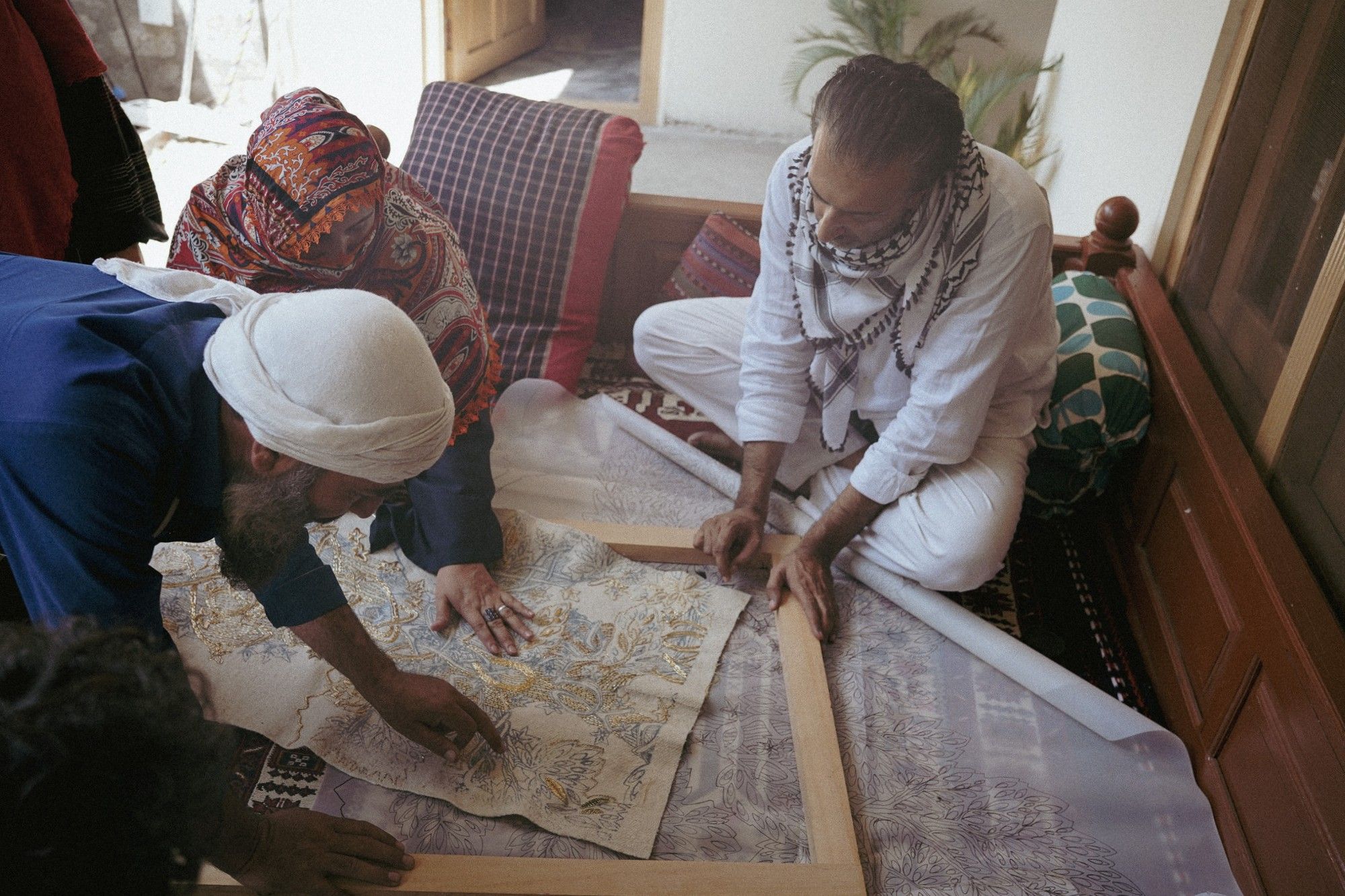
In Adil Iqbal’s work, cloth is never just cloth. Wool becomes a record of weather, labour, migration and survival; a handwoven textile becomes evidence of a relationship between people and land. Born and raised in Edinburgh to a Pakistani family, trained in textile design and later anthropology, Adil has spent the last decade moving between Scotland and Chitral, documenting and reimagining endangered textile knowledge through design, fieldwork and storytelling.

His studio practice, Twilling Tweeds, grew out of a simple but profound observation: that the wool cultures of the Outer Hebrides and the Hindukush, though geographically distant, share an intimacy with climate, remoteness and making. Through collaborations with weavers, embroiderers and shepherds, he has developed textiles, research projects and exhibitions that treat craft not as nostalgia, but as a living system of knowledge. Alongside this work, he co-founded the Làlgar Foundation in Chitral, where he is building longer-term structures for documentation, education, slow production and the preservation of Shu, the endangered handwoven wool cloth at the centre of much of his research.

What emerges from Adil’s practice is a challenge to the way contemporary culture often talks about heritage. He argues that indigenous craft traditions are not quaint survivals or decorative references, but sophisticated ways of thinking through ecology, economy, beauty and belonging. In the conversation that follows, we speak about Chitral, Twilling Tweeds, the future of Shu, the politics of wool, and why craft, for him, is “thought made visible.”
Adil, you first visited Chitral in 2011 and have spoken about feeling a strong sense of belonging in Chitral. Could you elaborate a little about this?
I arrived in Chitral thinking I was travelling to a place. What I didn’t expect was that it would feel, almost immediately, like recognition. As a Scottish–Pakistani person, I grew up with Pakistan as inheritance, texture, story and absence – always present, but never fully held. Chitral was the first place where those fragments began to gather into something more whole. It wasn’t nostalgia. It was a deeper sense of orientation.
What stayed with me was the intelligence of everyday life: the way knowledge moved through wool, weather, hands, architecture, memory and ritual rather than through formal institutions. I became less interested in ‘craft objects’ as isolated things and more interested in the worlds around them…who makes, who remembers, who leaves, who stays, what survives. That first visit altered the course of my life.

You now spend time between Scotland and Chitral. What does daily life in Chitral look like for you, and how does it shape your practice?
My practice sits at the intersection of design, anthropology, business and cultural stewardship. I’m interested in how research, co-creation and material intelligence can come together to build alternative economies – ones in which beauty, dignity, livelihood and intellectual heritage are not separated, but held in relation. For me, the studio, the non-profit, the fieldwork and the object are all part of the same enquiry: how do we create forms of commerce and collaboration that honour land, labour, memory and the people who carry them? Daily life in Chitral is not separate from my practice; it is the practice.
A day might begin with tea and conversation with a weaver, move into the studio to review sampling or embroidery, then open out into field visits, documentation, writing, or simply listening. There is a lot of quiet observation in my life there, not research in the extractive sense, but in the slower, relational sense of paying attention. That rhythm has changed how I think as a designer. It has made me less interested in novelty and more interested in continuity, adaptation, labour, dignity and ecological limit. It has also shaped my writing. Through Peristan Journal, I’ve tried to create an editorial space where these field notes, memories and encounters can live, not simply as documentation, but as part of a wider conversation around wool, land, migration and cultural memory.

What are you currently working on, and what feels most important to you in your work right now, particularly with the current global chaos?
Right now, I’m working across a few interconnected worlds. Through Twilling Tweeds, I continue to develop a cross-cultural design studio language between Scotland and Chitral, using wool, storytelling and material intelligence as a way of imagining more sustainable textile futures. It began as a way of thinking through both places at once, not flattening their differences, but allowing them to speak to one another through fibre, labour and landscape. In Scotland, I’m particularly interested in how local wool can help rebuild slower, more place-rooted fashion and textile systems, grounded in care, provenance and ecological limit.
Through Làlgar Foundation, I’m focused on building longer-term structures around endangered knowledge: atelier practice, documentation, education, slow production, dignified collaboration with local communities, and the foundations for a wool academy and weaving school rooted in Chitral’s own material culture. Alongside that is White Gold, a deeply ambitious cross-cultural textile project I’m co-developing with Xenia von Poser. The work takes the traditional shepherd’s cloak as its starting point and reimagines it through Chitrali Shu, gold embroidery, and a dialogue between the mountain worlds of Scotland and the Hindukush.

For me, the cloak is never just a garment. It is architecture, protection, labour, mythology, masculinity, weather, and memory all at once. White Gold asks what happens when that form is treated not as folklore, but as a serious contemporary art language. Working with artisans in Chitral, the cloaks have been developed slowly and collaboratively, carrying within them pastoral life, inherited knowledge, and the changing ecologies of wool. The project has expanded beyond object-making into something more atmospheric and symbolic – a meditation on value, land, and the quiet majesty of mountain cultures.
What I love about the project is that it sits precisely where my practice wants to be: between design and anthropology, between material intimacy and exhibition scale, between local specificity and wider cultural conversation. It is a project about beauty, certainly, but also about co-creation, slowness, and honouring the worlds that make such beauty possible. In a time marked by war, extraction, climate breakdown and cultural flattening, I’m interested in forms of practice that are slower, more reciprocal, and more accountable. I want to make beautiful things, yes, but I also want to ask who they serve, who they sustain, and what kind of future they imagine.

‘Shu’ is at the centre of your work. What makes this material so special, and why is it important to preserve it today?
Shu is not just a fabric, it is an ecology. Over the last few years, I’ve spent a great deal of time documenting this cloth through the Endangered Material Knowledge Programme, and that process only confirmed how much it contains: sheep, pasture, altitude, water, felting, warmth, labour, and a mountain philosophy of survival. In Chitral, wool is inseparable from climate and livelihood, so Shu becomes much more than ‘material;’ it becomes a record of environmental change, economic fragility and continuity of knowledge. What moves me about it is its honesty. It can become a pakol, a shepherd’s cloak, a wall piece, a utilitarian textile, or a deeply intimate object – but it never loses its relationship to place. In a world flooded by synthetic sameness, Shu offers another proposition entirely: slowness, repair, durability and belonging.
That is why preserving it matters. When these systems disappear, what is lost is not only a product, but a vocabulary of living – gesture, timing, local intelligence, intergenerational care, and a way of being with land rather than against it.

Through Twilling Tweeds, you’ve connected artisans in Scotland and Chitral. What have you learned from bringing these two worlds together?
Twilling Tweeds emerged from a desire to build a design studio that could move between two mountain cultures without flattening either of them. For me, Scotland and Chitral are connected not because they are the same, but because each has a deep relationship to wool, weather, labour and remoteness. Both understand cloth as atmosphere, not just surface. What I’ve learned is that cross-cultural work only becomes meaningful when it goes beyond aesthetic borrowing. The real work is trust, time, listening and restraint. It’s about allowing difference to remain intact while still finding points of resonance. Done well, it can create a kind of third language, not wholly Scottish, not wholly Chitrali, but something in between, held together by respect. Done badly, it becomes extraction. I’m always trying to stay alert to that line.

With the Làlgar Foundation, you’re working closely with local communities. What kind of impact are you hoping to create through this work? Also can you tell me a little about the slow fashion pieces that are being made through the foundation?
With Làlgar, the impact I care about most is structural. Arshad Irfan, my co-founder, and I are both interested in building something that goes beyond beautiful objects. Of course I care about garments, textiles, editions and research outputs, but I’m just as concerned with what sits beneath them: confidence, continuity, livelihood, visibility, training, dignity, and forms of work that allow people to remain rooted without being trapped.

What I want Làlgar to help create is a future in which craft is no longer treated as relic or folklore, but understood as living knowledge, and, where it asks to be, as art. That distinction matters to me. So much indigenous making is still viewed through the lens of utility or heritage alone, when in fact it often contains enormous aesthetic intelligence, conceptual depth and emotional force. Through Làlgar, we’re trying to build longer-term structures around endangered skills, atelier practice, documentation, education, slow production, and, in time, the foundations of a wool academy and weaving school rooted in Chitral’s own material culture. The slow fashion pieces emerging through the foundation reflect that wider vision: waistcoats, pouches, wall-based works, and small textile studies made with Shu, embroidery and a strong sense of provenance. I’m also currently developing a capsule collection of coats, more architectural than simply seasonal, thinking through warmth, structure, ceremony and the body in relation to mountain life. None of these are trend-led pieces. They are slower, more intimate objects that carry story, labour and place into contemporary life without losing their origin.

Your collaboration with NINDYAA on Modern Rituals brings traditional forms of dress into contemporary life. What was the idea behind this collection, and what did you want people to feel when wearing these pieces?
Modern Rituals began in conversation with Büşra Qadir, founder of NINDYAA, and from a shared desire to ask what ceremony might look like now if it moved beyond occasion and into daily life. I wasn’t interested only in garments, but in a wider domestic language, pieces for the body and the home that could carry memory, symbolism and tenderness without feeling theatrical or trapped in revival. Together we developed a collection that moved between embroidered waistcoats, a shepherd cape, hand-dyed Shu wall hangings, table mats and coasters, all made from hand-woven Chitrali Shu in organic Kari wool. What mattered to me was that the pieces felt contemporary, tactile and quietly architectural – not heritage as display, but heritage as something lived with, sat beside, worn, and returned to.

Your shoka, now displayed at the National Museums Scotland, was developed in dialogue with Arshad Irfan. Can you tell us about that collaboration and what the piece represents?
The shoka at the National Museums Scotland is very close to my heart because it is not simply a garment in a museum collection, it is a living repository of Chitrali knowledge, labour and memory. The piece is a long-sleeved woollen robe made from Shu, a cloth created entirely by hand, from preparing the wool to weaving and felting. What matters to me is that every stage of Shu-making is embedded in the seasonal work and daily lives of people in Garam Chashma. It is not an isolated artefact; it is inseparable from pastoral life, climate, village labour and the Chitrali landscape.
The robe entered the museum through a collaboration shaped by research, trust and shared responsibility. At a moment when the making of Shu has become increasingly endangered by climate change, migration and the erosion of intergenerational transmission, the shoka became a way of holding both continuity and fragility in one form.

Arshad Irfan was central to that conversation. He is a historian, cultural thinker and deeply important collaborator in my work. Our dialogue began from a shared concern for Chitral’s material culture, not as static heritage, but as something intellectually, emotionally and socially alive. The robe was tailored based on an heirloom shoka from Arshad’s family, inherited from his great-grandfather, Mirza Ghufran Farigh, and stitched at home by his wife, Sheli ku Nani, around 1923. That domestic lineage matters enormously to me. It reminds us that what enters museums often begins in women’s labour, in ancestral care, and in homes rather than institutions.
What the shoka represents for me is not nostalgia, but continuity under pressure. It asks what it means to keep a mountain textile tradition alive when the ecology that sustains it is changing. It also demonstrates the power of co-creation: Arshad’s historical and familial connection, my design and anthropological practice, and the expertise of the makers themselves all come together in the garment. In that sense, it is not the work of one author. It is a collective text in wool.

What do you want the world to truly understand about indigenous crafts, particularly those from Chitral?
That they are not minor arts. They are not quaint survivals. And they are certainly not moodboards for luxury fashion. Indigenous crafts from Chitral are living systems of intelligence. They hold environmental knowledge, economic adaptation, aesthetic philosophy, spiritual rhythm and social memory. They are often shaped under extraordinary conditions – altitude, remoteness, climatic instability, political neglect – and what emerges is frequently subtle, durable and deeply sophisticated.
I want the world to understand that craft is not the opposite of thought. In places like Chitral, craft is thought made visible. It is theory in wool, ethics in thread, cosmology in form. If we lose these practices, we do not just lose beautiful things, we lose ways of knowing.


Leave a Reply